Preventing Child Sexual Abuse

Knowledge is power. I was pleasantly surprised to see a very well written article entitled, “Protect Your Child from a Predator” in my November 2012 issue of Parent’s Magazine. I appreciate the renewed efforts to educate people about the prevalence of child sexual abuse even though it’s been sparked by the tragedy at Penn State. But that’s how we make meaning out of tragedy, isn’t it? By helping prevent the same horror from happening to others, we can create something good out of something really awful.

Here are some highlights from the article that I think every parent, person who wants to be a parent, and anyone else who thinks kids deserve to live a childhood free from those who would steal their innocence should know:

–       1 in 4 girls and 1 in 6 boys will be sexually abused before they turn 18 (the National Sexual Violence Resource Center).

–       90% of offenders are relatives of the victim, or acquaintances such as neighbors, family friends, teachers, and coaches. These folks appear to the outside world to be warm and caring, loving and respectful.

Why most prevention strategies we’ve heard aren’t helpful:

–       Expecting kids to sort out negative touch and positive touch can be a tall order, especially because it doesn’t always start out feeling “yucky.” Also, some sexual abuse doesn’t begin with touch, but rather exposure to pornography or the offender’s body.

–       Saying things like, “you should scream” or “you should run” puts the burden on the child and sends the unintended message to a child who has already been abused that the child was responsible for the abuse by not protecting him/herself.

Instead, do this:

–       Read the entire article.  Please.  It gives an age-by-age guide of how to prevent abuse, as well as clues on knowing who’s in your child’s life, recognizing red flags, and how to talk about abuse. It also lists resources about where to turn for help.

If you are a survivor of sexual abuse, I urge you to deal with it if you haven’t already. Your story needs to be told in a safe environment. Let me know if you’d like help finding that safe environment. Blessings to you on your journey.


sexual communication

Talking about sex can be difficult. There are many reasons for this, but mostly I think the reasons lie somewhere in between the opposing messages of religion and culture. Religion, because of the church’s relative silence (or the message that sex is “bad”) and culture’s abuse and misuse of sex and sexuality. The idea that sex has to be illicit to be good and that sex is “just” physical.  We bring these confusing and distorted messages with us into marriage.  And, thinking that marriage would solve them; we often feel disappointed. Unsatisfied. Like there is more that we are missing.

So, in an effort to increase passion, some folks resort to adding “illicit” stuff into the mix. From watching pornography together to inviting other people into their bedrooms…it works for a little while. But by temporarily increasing passion in this way, they find themselves further from true intimacy than ever. Further from what they really craved in the first place. Connection. Being known.

I am pretty good with words. But sex is something that I have a hard time describing accurately. It is sacred. And while the Lord has redeemed it for me in so many ways, I still struggle to remember the Truth sometimes. And so, that’s why I’m going to share with you someone else’s words, I hope you find them as powerful as I do:

“Sexual union is first and foremost a means of communication. We communicate powerful messages to each other and the Lord when we join ourselves sexually. It is our most intimate form of communication, enabling us to say things about our spiritual oneness that words cannot.

The word intercourse conveys this notion of communication. It is not exclusively a sexual term but simply means ‘to have an exchange or communing between persons.’ Couples must ensure that the messages of their verbal intercourse and their relational intercourse line up with the messages of their sexual intercourse. If they are communicating love throughout the day in the ways they serve, honor, and cherish each other, then the joining of their bodies in lovemaking bears testimony to that love. If, however, they are communicating anger, hatred, criticism, neglect, or disdain, the statement of their sexual union becomes a lie. With their bodies they are saying, ‘I love you so much that I want to have every part of you and to give you every part of me’; but they have communicated something entirely different throughout the day.”

(From the book, “When Two Become One” by Christopher and Rachel McCluskey).

I know I’ve barely scratched the surface. But the main message I’m hoping to get across is this: Sex is Sacred. It makes me sad to think about how often we exchange this beauty for something false or incomplete. Physical intimacy should be an extension of the emotional and spiritual intimacy you share with your spouse. My hope is that you will one day be able to experience sex the way I think we were made to: to feel safe enough and loved enough to bring more than just your body into lovemaking, but your soul and mind as well.

intimacy in marriage

How would you define intimacy in marriage? Friendship? Connection? Spiritual closeness? Sex? All true. All good things. And yet…I think I can define it simply.

Intimacy is knowing.

A facebook friend posted a comment recently that made me smile. She was bragging on her husband for buying her lavender and vanilla scented trashbags. She went on to say that it may not seem like a big deal, but that he knows her. And it feels good to be known.

Ah yes, it feels good to be known.

Sadly, I would argue that this seems to be one of the fundamental things missing from so many marriages. Couples barely like each other, let alone take the time to know one another.

What turns her on? Makes him laugh? What is stressing him out right now? Who are her best friends? How does she act when she’s nervous? Lonely? Hungry? What was his childhood like? Her biggest fear?How often do we take the time to enter each other’s worlds? To really know each other with our bodies? To really see each other? How often do we say the words, “what can I do to help?”

Unfortunately, many men and women don’t experience this kind of intimacy in marriage.

So then we begin to withhold our love from each other. We don’t offer because we feel we aren’t receiving. Our unmet needs and hurt feelings leave us violated, sad, and vulnerable to more pain. So we use anger as a defense to protect ourselves.

Anger can take many forms: impatience, a quick temper, depression, jealousy, or suspicion. Or passive aggressive forms: procrastination, silence, sarcasm, or avoidance. Our unmet needs make us feel fearful and rejected. The fear can take several forms: perfectionism, control and addictions (from the book, Intimate Encounters).

“What’s on the inside is what comes out when we’re squeezed.” – Dave Lewis

Steps toward healing and greater intimacy:

  1. Accept responsibility for your part in causing the hurts as well as your part in the healing.
  2. Show understanding. Your partner feels hurt. Do you care?
  3. Confess and repent. If you are a Christian this means agreeing with God. What does God say about being selfish, critical, dishonest, disrespectful, etc.?
  4. Talk to each other! Reconnect. Seek to know each other. This often requires making sacrifices to have time together, taking time to check in, and being honest about your feelings.

Ultimately, healthy couples will fight. They will get their feelings hurt. They will take out frustration on each other. I believe that a couple is in a good place when they can give each other the benefit of the doubt and seek to build each other up. I want couples to be in a relationship that is safe enough for both partners to feel free enough to be “naked and unashamed.”

So that they can be known, because it feels good to be known.

friendship matters

The other day I received an unexpected gift in the mail: the October issue of “Psychology Today”! There are several wonderful articles in the issue, but the highlighted article is called, “Life Lessons: 5 Truths People Learn too late” by Elizabeth Svoboda. And one of the truths in particular really hit home. Thus, the purpose of this post: I want you to know the truth because I think you might need to hear it as much as I did. So, without further ado…here it is:

“Lesson #4: Social Networks Matter: The strength of your friends is as critical for your health as the lifestyle choices you make.”

The highlights you don’t want to miss:

  • The higher the quantity and quality of your relationships, the longer you live.
  • People with active social lives were 50 percent less likely to die of any cause than their nonsocial counterparts.
  • Low levels of social interaction have the same negative effects as smoking 15 cigarettes day– and even worse effects than being obese or not exercising (from study by Julianne Holt-Lunstad of Brigham Young University).
  • The more social connections you have, the greater your ability to fight infection (from study by Sheldon Cohen of Carnegie Mellon University)

The takeaway?: “Stress has potentially negative effects on health and well-being, but knowing your friends have your back can prevent such fallout” (Cohen).


my dear friend Dana with our babies!

Wow! I knew supportive friendships were important, but I didn’t realize just how much! Here’s to reaching out, making time, and enjoying a friendship today!

To read the full article (and the other 4 life lessons!) click the following link: http://www.psychologytoday.com/collections/201209/life-lessons/lessons-loving


how to not start a fight

Most folks believe that communication is the key to a happy marriage. And yet, usually when couples say they have a problem with communication they actually mean something like this: “we don’t know how to talk to each other without it turning into a fight” or “we don’t know how to talk to each other anymore.” Their problem is more specifically conflict resolution and a lack of intimacy/friendship.

So, my job is to figure out what folks really mean when they say, “we need to learn how to communicate better.” In many instances, I’m helping people learn how to start tough conversations about feelings and needs in the hopes of decreasing the chance of defensiveness and subsequently, an argument. Ultimately, my goal is not to prevent couples from fighting; it is to help them treat each other with respect.

A few tips for softening your start up:

  • Think before you speak. Calm down, decide what you really want to communicate, and avoid the words “always” and “never.”
  • Put yourself in his or her shoes. Do you believe your partner deliberately and intentionally wanted to hurt or upset you? Try to lead with   some other softening statements like, “I know you’ve been busy…” “I don’t think you meant to…” or  “I can understand why…”
  • Be specific about the behavior you would like changed. Name-calling and character bashing are just mean (and do not help get your point across)! Neither does yelling. If you want to be heard, don’t be mean, stop yelling, and speak rationally.
  • Stop fighting to be right. If one of you “wins,” you’ve both lost. Understanding is the new “right” and if you achieve it, you both are winners.
  • It’s ok to let some things go. But do not, I repeat: do not stuff your feelings and allow yourself to get bitter or resentful.

Good luck getting started!

affair prevention

I tell my clients, “Affairs don’t begin in bed.” What I mean is this: there are often a series of poor boundaries and bad choices that happen long before the affair. They are preventable and here’s how:

  1. Realize that you are capable of having an affair. We all are. You need to realize this or else you will not enforce boundaries like you should. I hear this a lot, “I never thought I would do something like this.” And we never do. Good people do bad things. all. the. time. You are not immune.
  2. Talk to your spouse. Are you unhappy in your marriage? Feel as though something is missing? Angry? You are vulnerable to making decisions based on your (conscious or unconscious) desire to fill that missing piece and be happy. If talking doesn’t work, try counseling! Ignoring a problem will not make it go away. In fact, it will most likely get worse.
  3. Get healthy. If you have an untreated addiction or mental illness (particularly bi-polar disorder), please seek treatment. You are more vulnerable to having an affair.
  4. Set clear boundaries. Decide with your spouse what is acceptable behavior with the opposite sex. I can’t make my clients be as conservative as I am in my own marriage with this, but I have one rule that I am adamant about: do not complain about your partner with someone of the opposite sex. In fact, be very wary of who you complain about your partner with in general. Choose one or two trustworthy friends of the same sex when you need to vent on occasion. Also, use facebook wisely. I don’t think you need to be friends with the “one who got away.” Block the person or get rid of your account if you are struggling with this. I have seen too many affairs begin on facebook. Not worth it!
  5. Be accountable. You will feel attraction to someone other than your spouse at some point. That is normal. What is not ok is keeping this a secret (although you do not need to tell your spouse about this unless you have acted on the attraction). Hiding things and trying to push them down has a way of making them get bigger. Find that trustworthy same sex friend and say something like this: “there’s just something about him /her that I find attractive. I will have extra boundaries with this person and if it continues to grow I will remove this person from my life to protect my marriage and family.”
  6. Learn about love. Love is a choice. You will always feel something is missing if you believe love is the same thing as the “in love feeling.” Hollywood and fairy tales set us up to believe that love is always supposed to be exciting, easy and make us happy (affairs are exciting…that is much of the draw). See my blog on love for more about this.

If this blog is too late, please know that I have seen grace and forgiveness in sessions with clients. It will not be an easy road, but there is hope and healing is possible. I hope you’ll seek wise counsel and begin the process, friend. You are not alone.

the transformation is complete!

For those of you who have yet to experience baby-proofing your house, let me tell you: it is a … curse word! Could decent looking baby gates cost any more?! I’m not sure if it’s because he’s a boy, or because he’s Caleb, or both…but if there is a sharp corner, his head will find it. If there is something to climb, he will climb it, and fall (on his head). If there is a plug, he will pull it out and insert it into his mouth. If there is a button, he will push it. Shall I go on?

Yesterday he stepped on one end of a cat toy and it flew up into his nose, bruising it. (It looks a little better today, but it’s still swollen). All that to say, as a parent you will at some point come to the conclusion that you do all you can to prevent pain and injury, but your kid is still going to get hurt. I’m just going to try and make sure he doesn’t kill himself too badly. Of course, I’m failing to mention here the times he’s sustained injury due to my own stupidity. (Oops, just mentioned it)!

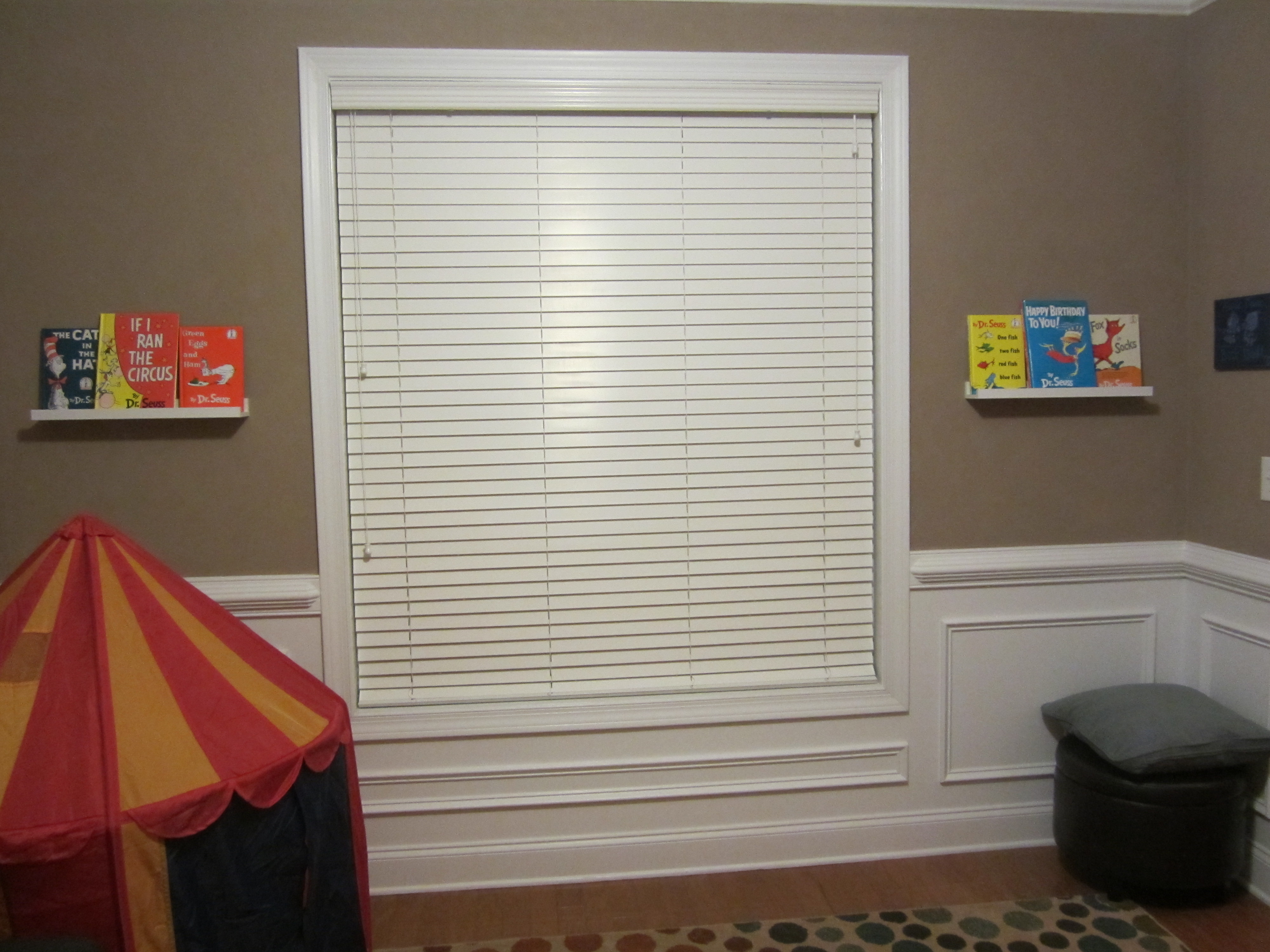
Baby-proofing and lack of space are the reasons we traded in our dining room table for a big plastic play door (among other things). We had a tight budget so I had to get a little creative! Unfortunately I’m not artistic, so it isn’t fancy, but it suits us just fine…and more importantly, Caleb loves it and has a relatively safe, confined space to play!

Before:

After:

Couch: Ikea. It folds out into a bed/fort!

Tent: Ikea

Frames: Ikea

Inside the frames are Dr. Seuss flash cards backed with colored paper and a book that Caleb destroyed (this was before I realized that he likes to eat paper) and I’d kept for a time such as this.

White Shelf: Walmart

Toy Organizer: Walmart

Canvas: Joann’s. I painted it and decorated it with an alphabet flash card set from the consignment store. Then I hot glued some mini clothes pins and put pictures of Caleb and our family inside. One day, I’ll display his artwork there.

Frames: Ikea. Filled with a few favorite greeting cards from Christmas, Mother’s Day and Father’s Day.

Floating Shelves to display books (Dr. Seuss, of course!): Ikea

Rug: Target

Toy door: baby consignment store, highly recommend checking one out! I just wiped this buddy down with many lysol wipes and saved over $50 on a toy that he loves!

Blocking off the room with gates was the trickiest business of all, but after ordering a gate that didn’t fit–we got this one with extensions and it worked like a charm! Our space is over 6 feet wide so we feared we wouldn’t be able to find a nice looking gate for this opening. So glad we found this!

Happy Playing, kids!

intimacy after baby

Having a baby is one of the most joyous and challenging times of your life. It’s normal for intimacy with your partner to take some time to adjust. There are about a million reasons for this difficulty, but here are a few:

–       Exhaustion

–       “Baby blues” or post-partum depression

–       Feeling isolated or alone

–       “Roller coaster” emotions, rapidly fluctuating emotions

–       Feeling unattractive and undesirable

–       Decreased or lack of sexual desire

–       Difficulty becoming aroused

A few helpful hints for surviving the next couple months:

  1. Talk! Adjusting to the role of becoming a mother is a process!  Tell your partner about how you’re feeling and ask for his help and understanding.
  2. Find support. Talk to other new moms you trust. It is so helpful to know that you aren’t alone!
  3. Get information. Ask your doctor about any physical difficulties with intimacy, the impact of breastfeeding on intimacy, etc.
  4. Ask for help. Consider investing in counseling, if needed.  If feelings of sadness or depression worsen and begin affecting your daily life, you may need a little extra help. Counseling can also benefit post-baby difficulties in your relationship. It can help ease the transition, restore sexual intimacy, and aid in understanding and communication.

Let me know if you’d like help finding resources!

yeah, he’s cute–and such a blessing, but life sure is more complicated!

logical consequences

I’ve made a few blogular promises that I need to make good on.  I’ll start with the follow up from this parenting post about sending an I-message. I promised to post on discipline in the form of logical consequences when the “I-message” fails to change behavior. So, here it is:

Logical consequences* are great because they help your child to learn responsibility and independence. Using logical consequences with your child instead of punishment helps your child to understand that their choices and actions can have consequences. For instance, the logical consequence of not putting dirty clothes in the hamper is that he must do his own laundry…or wear dirty clothes. Sounds good, huh?

Tips & tricks for using logical consequences:

1. Ask the child to help set the consequences. Ex. “I still have a problem with you leaving your belongings in the kitchen. What do you think we can do to solve it?”

2. Give the child a choice:

There are 2 types of choices in using logical consequences:

  • Either-or choices: “Either you may…or you may…you decide.”
  • When-then choices: “When you have…then you may…”

3. Make sure the consequence is really logical. One key to this whole business is that the consequence is logically connected to the misbehavior. Children can more easily see the justice in this and accept their consequence with less resentment.

Not logical:

“Either come to dinner when I call or no TV for a week!” This consequence is arbitrary and will feel unjust. They may also know that you won’t reinforce it for more than a night or morning. Never threaten a consequence you aren’t willing to act on. More on that later…

Try something like this:

“Either come in to dinner when I call or it will get cold—and you may miss it altogether.”

4. Only give choices you can live with.

5. Keep your tone firm and calm.

6. Give the choice one time, then act to enforce the consequence.

7. Expect testing. Your child will test to see if you will do what you say you’re going to do. Be consistent!

8. Allow the child to try again after experiencing the consequences. Example: “It seems you have decided not to play outside this morning. Take care of your room and we can try again this afternoon.”

I’ll be trying these skills on my guy in a few short years…

Information taken from “Active Parenting Now” by Michael H. Popkin, Ph.D.

* this information is ideally used for kids aged 5-12